

The Deutsch-Jozsa algorithm, introduced by David Deutsch and Richard Jozsa in their 1992 paper Rapid solution of problems by quantum computation, marked an important early milestone in the development of quantum algorithms. The formulation familiar to us today—featuring the standard quantum circuit model and oracle—was later refined in 1998 by Richard Cleve, Artur Ekert, Chiara Macchiavello, and Michele Mosca in their paper Quantum algorithms revisited. Both papers are highly readable, and we encourage interested readers to consult them directly.

As a deterministic quantum algorithm, the Deutsch-Jozsa algorithm has limited direct practical applications. Its significance lies in demonstrating, for the first time, that quantum computation can achieve an exponential speedup over all deterministic classical algorithms. Studying this algorithm offers valuable insight into how quantum algorithms are structured and why they can outperform classical methods.
It is worth noting that this exponential separation holds only when compared with deterministic classical algorithms. If classical randomness is allowed, such an exponential advantage no longer appears. The first quantum algorithm to establish an exponential speedup over any classical stochastic algorithm is Simon’s algorithm, see this post.
Definition (Problem of the Deutsch-Jozsa Algorithm). Consider a function

that accepts 


For example, consider a one-bit input function 


Deutsch-Jozsa Algorithm: n=1 Case
Let us begin with the simplest example, namely the 
Classically, we would need to evaluate 


We do not concern ourselves here with how to implement
Exercise. As a simple practice, prove that
Proof. Consider the action of


Notice that 

Hence, the images of the basis states under
With the quantum oracle
We prepare two qubits: one for the input of 
- Apply Hadamard gates to both qubits:
.
- Apply the oracle:
.
- Apply a Hadamard gate to the first qubit:
.
- Measure the first qubit in the computational basis.
Let us examine what happens step by step. After steps 1 and 2, we obtain


Next, we use a simple but important trick: we rewrite the action of the oracle so that the value of 

valid for 


Ignoring the second qubit and the global phase, the first qubit is in the state


Our goal is to determine 
After applying the Hadamard, the state of the first qubit becomes


The probabilities of measuring the first qubit in the computational basis are then


Hence, if 

If 

In other words, a single query to the quantum oracle suffices to determine with certainty whether
The key mechanism at work here is quantum parallelism: in step 2, the oracle evaluates ff f across both inputs in parallel, storing the outcomes in superposition. The concluding Hadamard transformation then translates this superposed information into observable probability amplitudes, from which we can efficiently determine the answer.
Deutsch-Jozsa Algorithm
Now let us turn to the general case in which 

where 

This means we use the canonical encoding that maps each bit string to a corresponding computational basis state.
Exercise. Prove that the quantum oracle 
Proof. The operator 


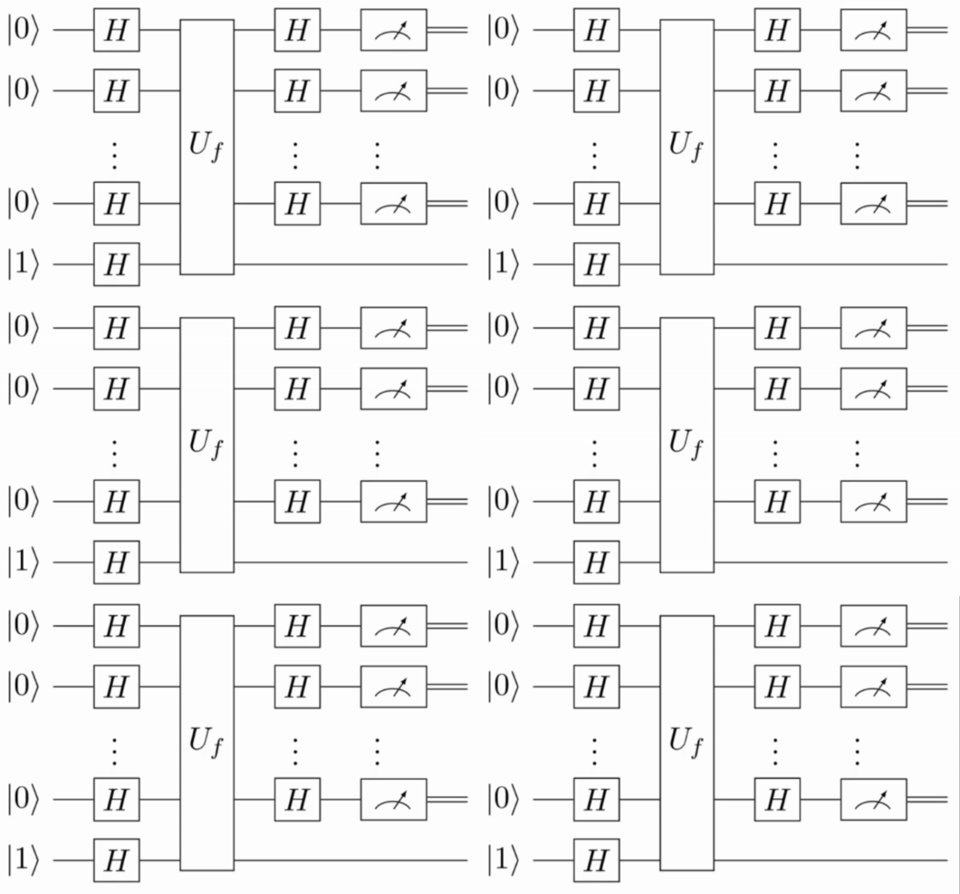
The quantum circuit for the Deutsch–Jozsa algorithm is shown in Figure 3. The algorithm proceeds as follows:
- Initial State: Prepare an n-qubit input register in the state
and a single output qubit in the state
.
- Hadamard Transform: Apply the Hadamard gate to each qubit:
.
- Oracle Query: Apply the quantum oracle
.
After applying the oracle, the state becomes,
using the identity.
The output qubit is no longer entangled with the input register, so we can ignore it, leaving.
- Second Hadamard Transform: Apply
to the input register:
,
giving.
- Measurement: Measure the n-qubit input register. The outcome reveals the type of function:
- If
- If
Measuring
Exercise: Verify that the states at each step of the n-qubit Deutsch-Jozsa algorithm match the evolution described above for a given function
Classically, if we want to solve the problem by brute force, we need to check about half of the inputs, thus evaluating 
 Zhian Jia | 贾治安